IBM AI Governance
As a foundational part of the watsonx platform, watsonx.governance console enables process owners and risk stakeholders to communicate business goals, risks, and regulations to model developers, validators, and MLOps engineers. It provides new resources to help developers and validators build successful AI assets while ensuring alignment with organizational objectives and regulatory requirements.
Key Contribution: In 7 months, I unified three disconnected IBM products into watsonx.governance, reducing compliance workflow time and enabling 10,000+ users to govern AI without jumping between platforms.
IBM AI Governance
As a foundational part of the watsonx platform, watsonx.governance console enables process owners and risk stakeholders to communicate business goals, risks, and regulations to model developers, validators, and MLOps engineers. It provides new resources to help developers and validators build successful AI assets while ensuring alignment with organizational objectives and regulatory requirements.
Key Contribution: In 7 months, I unified three disconnected IBM products into watsonx.governance, reducing compliance workflow time and enabling 10,000+ users to govern AI without jumping between platforms.
IBM AI Governance
As a foundational part of the watsonx platform, watsonx.governance console enables process owners and risk stakeholders to communicate business goals, risks, and regulations to model developers, validators, and MLOps engineers. It provides new resources to help developers and validators build successful AI assets while ensuring alignment with organizational objectives and regulatory requirements.
Key Contribution: In 7 months, I unified three disconnected IBM products into watsonx.governance, reducing compliance workflow time and enabling 10,000+ users to govern AI without jumping between platforms.
YEAR
2024 - 2025
Role
Sr UX Designer
RECOGNITION

YEAR
2024 - 2025
Role
Sr UX Designer
RECOGNITION
YEAR
2024 - 2025
Role
Sr UX Designer
RECOGNITION

Context
Context
The Problem: A Broken Experience
Organizations were struggling with AI governance across multiple disconnected platforms. Users had to jump between systems, losing context and creating dangerous gaps in oversight. Model developers couldn't access business requirements. The risk teams couldn't see operational metrics. Nobody had a complete picture.
AI use cases, risk elicitation, training metrics, development details, validation results, and issues were scattered across different tools. This fragmentation meant:
Developers built models without understanding compliance requirements.
Risk officers assessed models without development context.
Validators worked in isolation from business objectives.
Executives made decisions based on incomplete information.
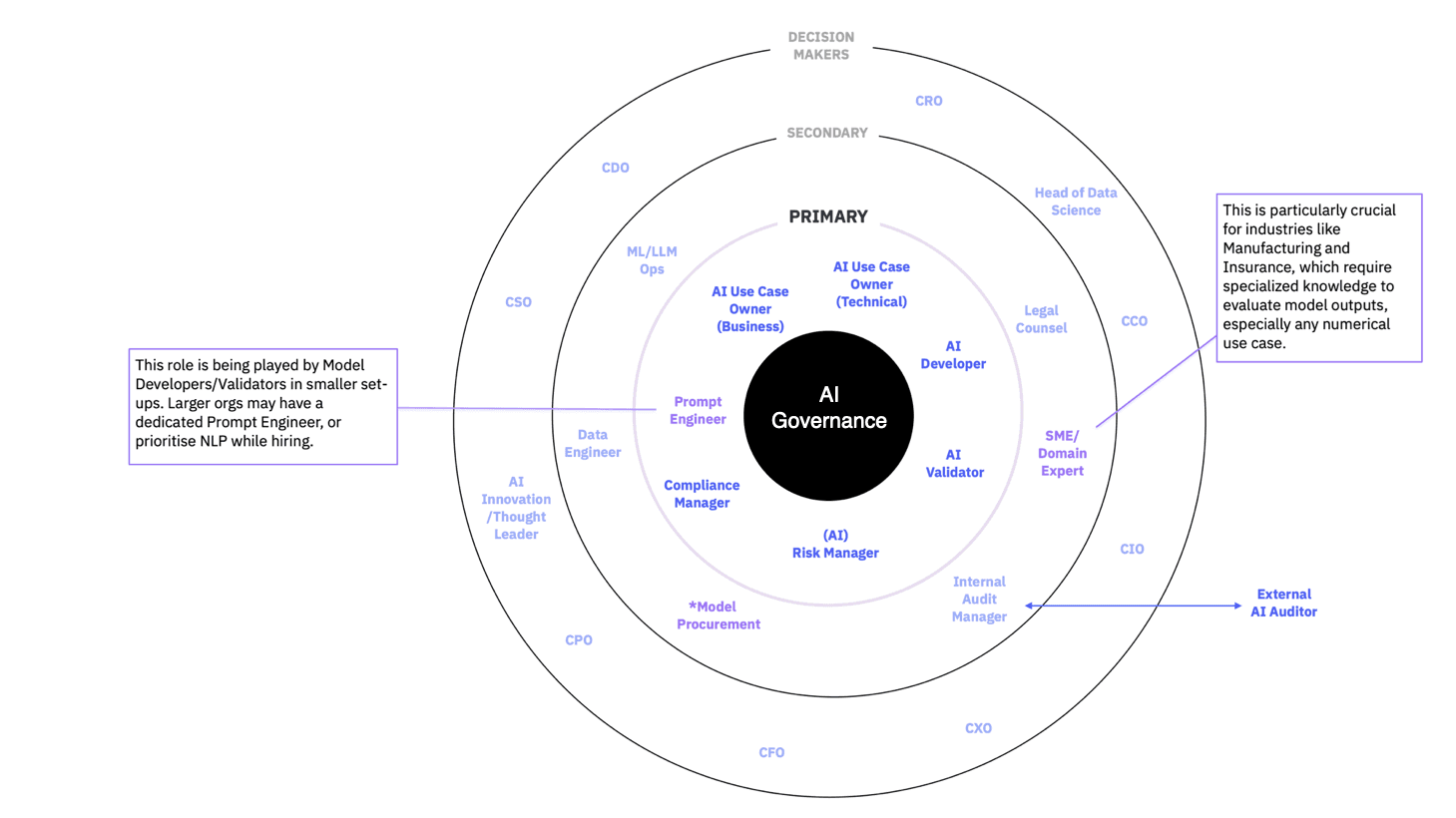
Understanding the AI Development Ecosystem
The Players
Build and Test Phase:
The AI development team plays a critical role in the AI Governance framework as they are responsible for designing, building, and evaluating AI assets.
Plan and Protect Phase
Model Owners: Take ownership and accountability for AI outcomes, facilitating communication to align models with organizational goals.
Risk & Compliance Teams: Act as safeguards, ensuring AI is developed responsibly, ethically, and in compliance with laws and regulations.
The Stakes
The AI governance market was racing toward $1 billion by 2026 (65.5% CAGR), driven by:
Regulatory tsunami: EU AI Act and FISMA demanding immediate compliance.
Cost explosion: Ungoverned AI creating massive financial and reputational risks.
Trust crisis: High-profile AI bias cases destroying public confidence.
The Problem: A Broken Experience
Organizations were struggling with AI governance across multiple disconnected platforms. Users had to jump between systems, losing context and creating dangerous gaps in oversight. Model developers couldn't access business requirements. The risk teams couldn't see operational metrics. Nobody had a complete picture.
AI use cases, risk elicitation, training metrics, development details, validation results, and issues were scattered across different tools. This fragmentation meant:
Developers built models without understanding compliance requirements.
Risk officers assessed models without development context.
Validators worked in isolation from business objectives.
Executives made decisions based on incomplete information.
Understanding the AI Development Ecosystem
The Players
Build and Test Phase:
The AI development team plays a critical role in the AI Governance framework as they are responsible for designing, building, and evaluating AI assets.
Plan and Protect Phase
Model Owners: Take ownership and accountability for AI outcomes, facilitating communication to align models with organizational goals.
Risk & Compliance Teams: Act as safeguards, ensuring AI is developed responsibly, ethically, and in compliance with laws and regulations.
The Stakes
The AI governance market was racing toward $1 billion by 2026 (65.5% CAGR), driven by:
Regulatory tsunami: EU AI Act and FISMA demanding immediate compliance.
Cost explosion: Ungoverned AI creating massive financial and reputational risks.
Trust crisis: High-profile AI bias cases destroying public confidence.
Challenge
Challenge
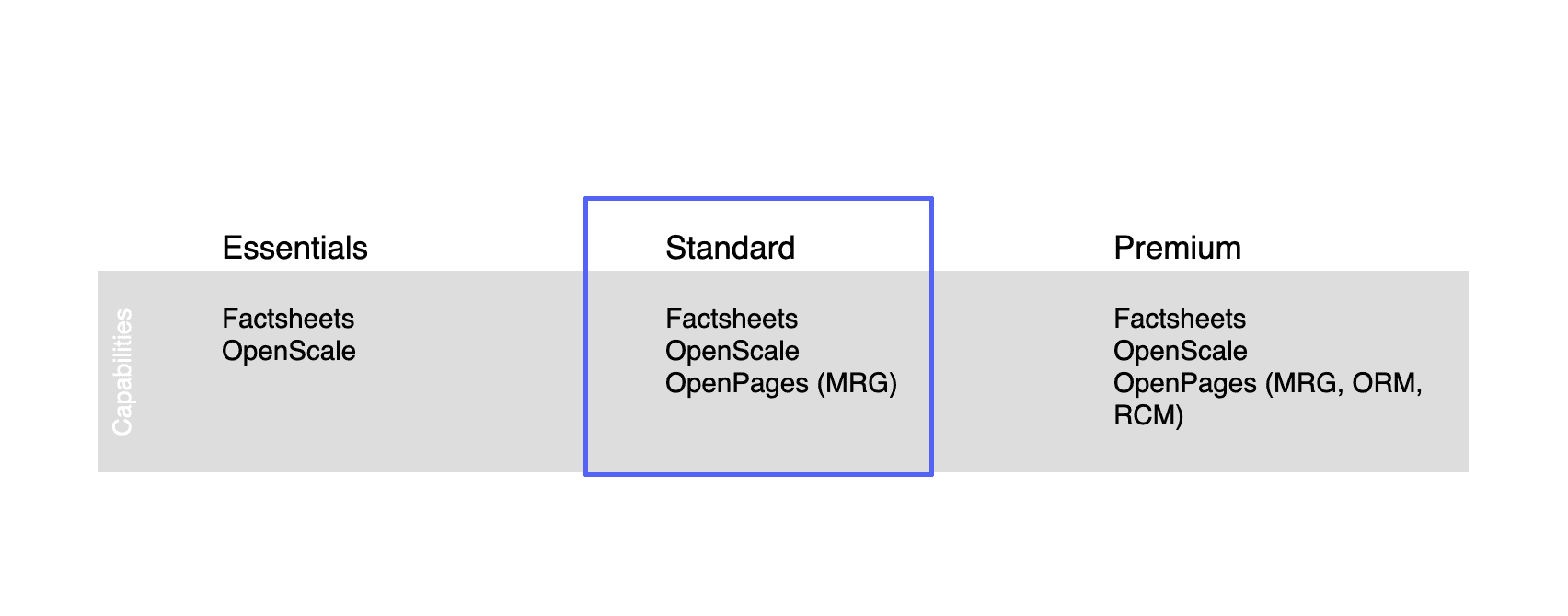
Unifying Three Worlds
Integration Complexity
Collaborating with other designers to merge three mature IBM products, each with 10+ years of legacy:
IBM OpenPages: Enterprise GRC foundation with customizable workflows.
IBM OpenScale: Real-time model monitoring and bias detection.
IBM FactSheets: Automatic documentation and audit trails.
Human Complexity
Seven core personas with completely different needs:
Model owners speaking business language.
Developers thinking in code and metrics.
Validators requiring isolation and independence.
Risk officers needing compliance mapping.
Admins managing access and permissions.
Executives wanting dashboard summaries.
Dev managers coordinating resources.
Time Complexity
7-month deadline to GA.
5 global teams across timezones.
Zero existing precedent for this type of integration.
Thousands of models to govern across environments.
Unifying Three Worlds
Integration Complexity
Collaborating with other designers to merge three mature IBM products, each with 10+ years of legacy:
IBM OpenPages: Enterprise GRC foundation with customizable workflows.
IBM OpenScale: Real-time model monitoring and bias detection.
IBM FactSheets: Automatic documentation and audit trails.
Human Complexity
Seven core personas with completely different needs:
Model owners speaking business language.
Developers thinking in code and metrics.
Validators requiring isolation and independence.
Risk officers needing compliance mapping.
Admins managing access and permissions.
Executives wanting dashboard summaries.
Dev managers coordinating resources.
Time Complexity
7-month deadline to GA.
5 global teams across timezones.
Zero existing precedent for this type of integration.
Thousands of models to govern across environments.
Process
Process
Initial Discovery
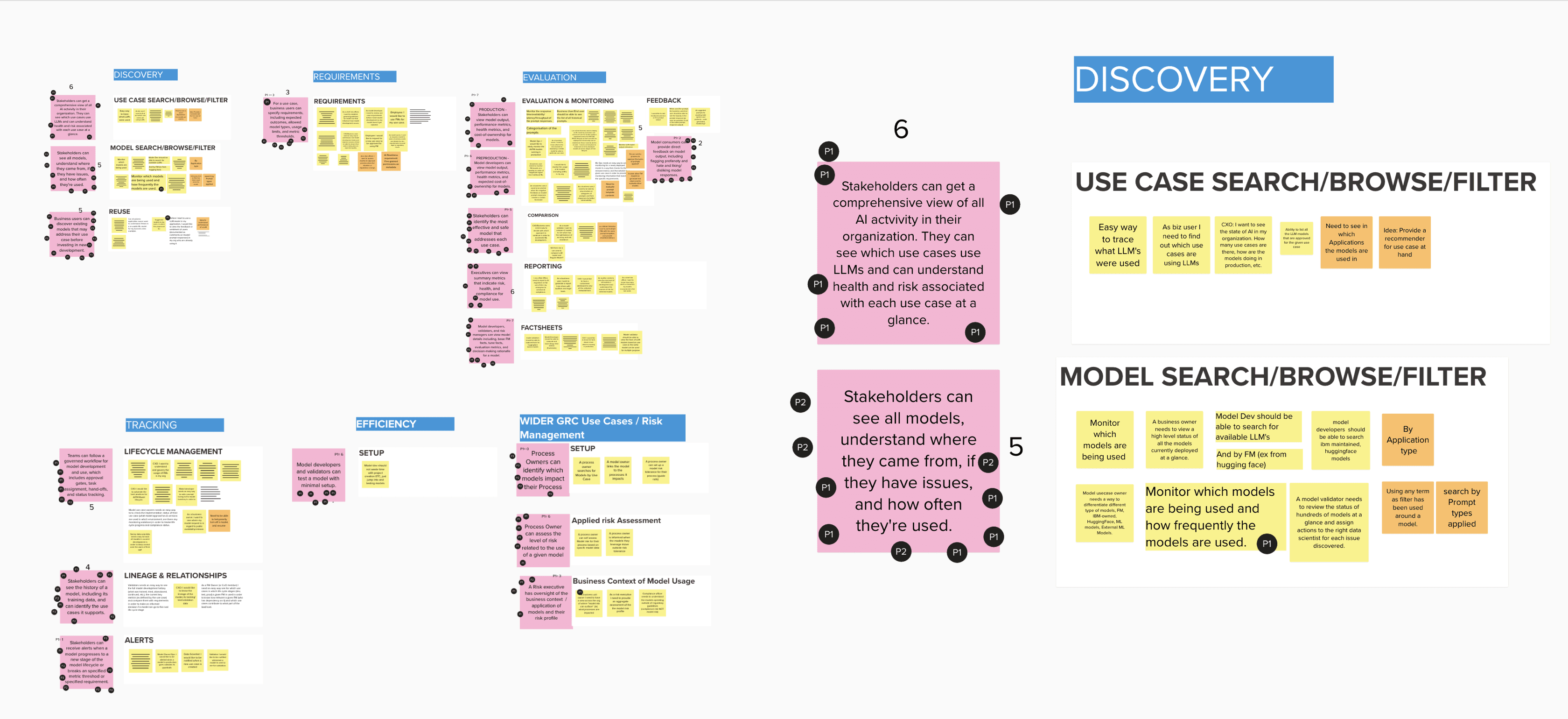
Conducted interviews with 25+ compliance officers and model developers across many large enterprises.
The Aha Moment
Users weren't afraid of AI—they were afraid of explaining AI decisions to auditors. They needed a translation layer between technical complexity and business accountability.
Market Gap
Competitive analysis revealed nobody had solved visual risk mapping for AI governance. Everyone had pieces, but no one had the complete picture.
Identifying Opportunity Areas
Collaborating with designers from .ai and .governance design teams to uncover the real opportunities:
As-Is Scenario Mapping
Documented current broken workflows.
Identified handoff failures between teams.
Mapped information silos.
Value Definition Critical questions we answered:
What do we promise users with only .ai?
What do we promise with only .governance?
What's the transformative promise when they work together?
Opportunity Discovery Found five areas where integration could unlock entirely new experiences that neither product could deliver alone.
Collaborative Ideation
Moved from problems to possibilities:
Created big ideas and sketches.
Built wireframe concepts testing different mental models.
Achieved cross-team alignment on unified vision.
Key question driving this phase: How do we leverage these opportunities to bring maximum value?
Scoping Based on Value + Feasibility
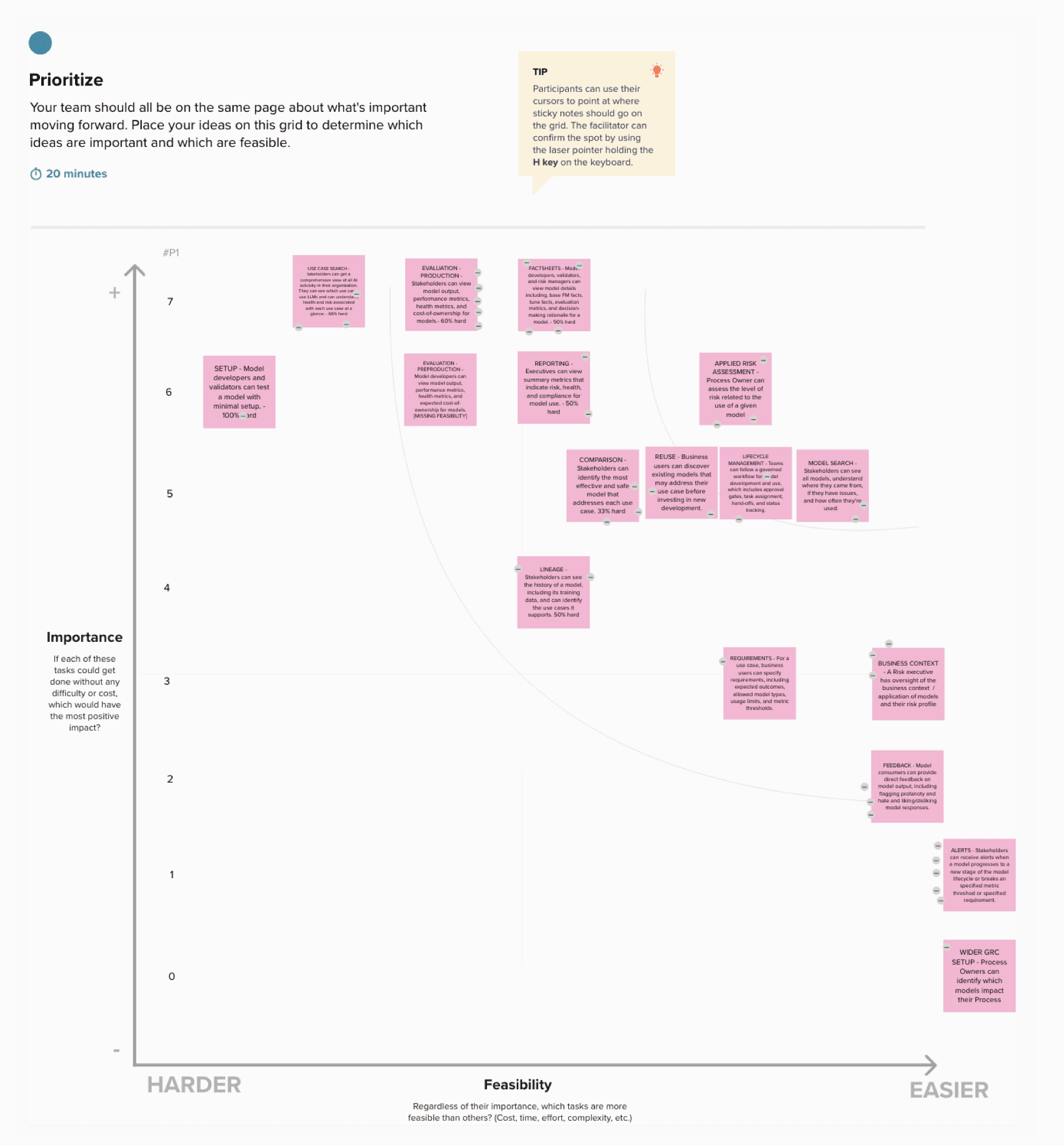
Strategic partnership with Product team to understand reality:
Feasibility Mapping
Simple implementations vs. complex multi-quarter projects.
Technical boundaries of each system.
Integration points and limitations.
Value Sweet Spot Analysis
Where could we deliver maximum impact?
What would users actually use daily?
What would differentiate us from competitors?
7-Month Reality Check
What must we deliver for GA?
What could wait for post-launch?
Where could we take smart shortcuts?
Writing Value Propositions
Collaborated with PM to articulate clear value for each persona:
Model owners: Business alignment visibility.
Developers: Compliance requirements in context.
Validators: Independent verification workflows.
Risk officers: Proactive monitoring capabilities.
Initial Discovery
Conducted interviews with 25+ compliance officers and model developers across many large enterprises.
The Aha Moment
Users weren't afraid of AI—they were afraid of explaining AI decisions to auditors. They needed a translation layer between technical complexity and business accountability.
Market Gap
Competitive analysis revealed nobody had solved visual risk mapping for AI governance. Everyone had pieces, but no one had the complete picture.
Identifying Opportunity Areas
Collaborating with designers from .ai and .governance design teams to uncover the real opportunities:
As-Is Scenario Mapping
Documented current broken workflows.
Identified handoff failures between teams.
Mapped information silos.
Value Definition Critical questions we answered:
What do we promise users with only .ai?
What do we promise with only .governance?
What's the transformative promise when they work together?
Opportunity Discovery Found five areas where integration could unlock entirely new experiences that neither product could deliver alone.
Collaborative Ideation
Moved from problems to possibilities:
Created big ideas and sketches.
Built wireframe concepts testing different mental models.
Achieved cross-team alignment on unified vision.
Key question driving this phase: How do we leverage these opportunities to bring maximum value?
Scoping Based on Value + Feasibility
Strategic partnership with Product team to understand reality:
Feasibility Mapping
Simple implementations vs. complex multi-quarter projects.
Technical boundaries of each system.
Integration points and limitations.
Value Sweet Spot Analysis
Where could we deliver maximum impact?
What would users actually use daily?
What would differentiate us from competitors?
7-Month Reality Check
What must we deliver for GA?
What could wait for post-launch?
Where could we take smart shortcuts?
Writing Value Propositions
Collaborated with PM to articulate clear value for each persona:
Model owners: Business alignment visibility.
Developers: Compliance requirements in context.
Validators: Independent verification workflows.
Risk officers: Proactive monitoring capabilities.
Key Experiences
Key Experiences
Proactively Detect and Mitigate Risks
Enabling users to identify potential risks and set safety guardrails for the development and deployment of AI models. Awareness of these guidelines and risk identification processes are vital to AI developers because they ensure that AI models are in alignment not only with political and social regulations, but also with organizational ethics and values.
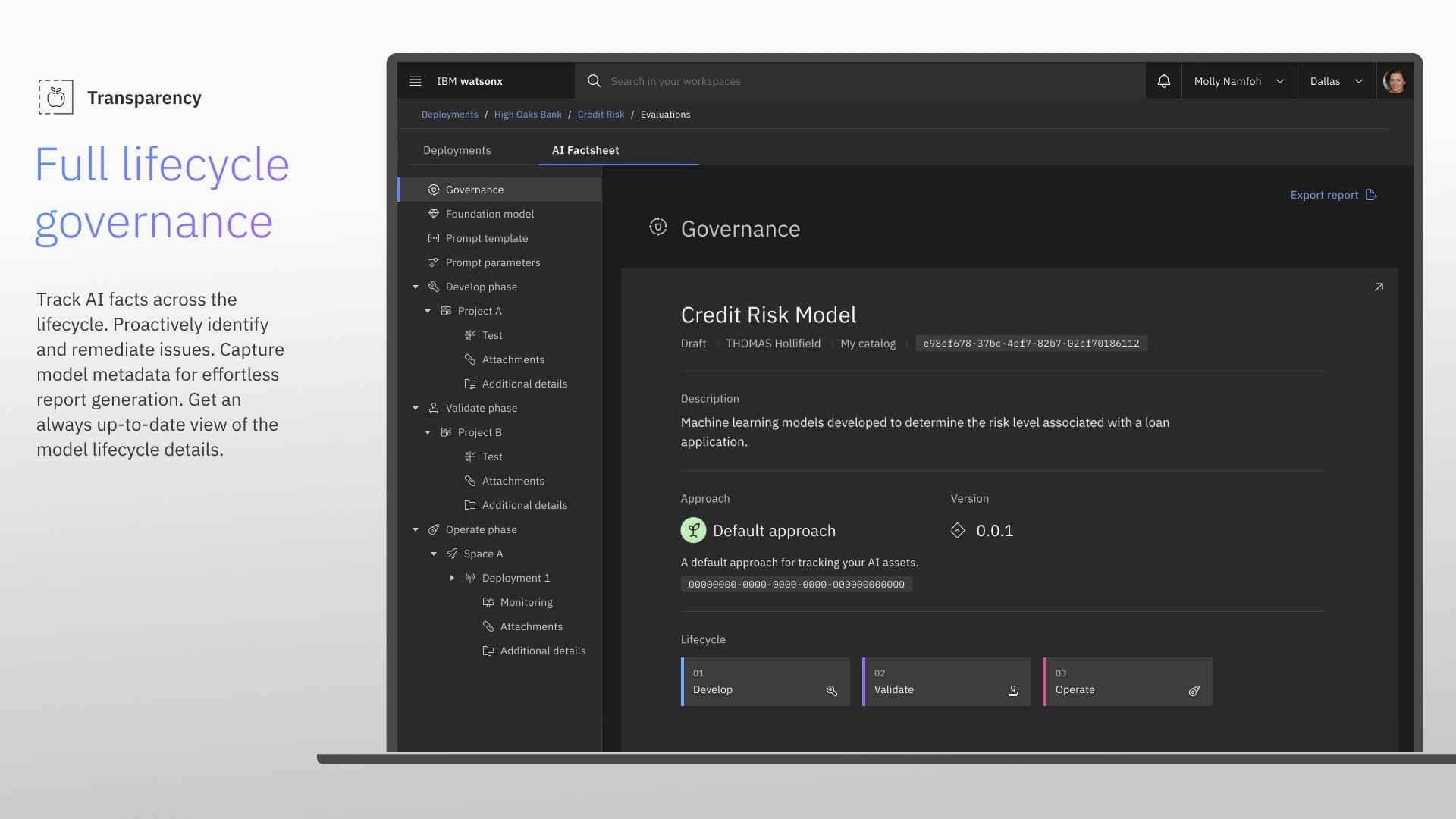
Build & track AI lifecycle transparently
Applications and platforms that are not optimized for AI can lead to bias and security risks. watsonx.governance automatically captures critical information related to the lifecycle of an AI asset in easily digestible and sharable AI factsheets. These factsheets serve as a transparent overview of how an AI model was built, providing a clear path to understanding its underpinning components and mechanisms.
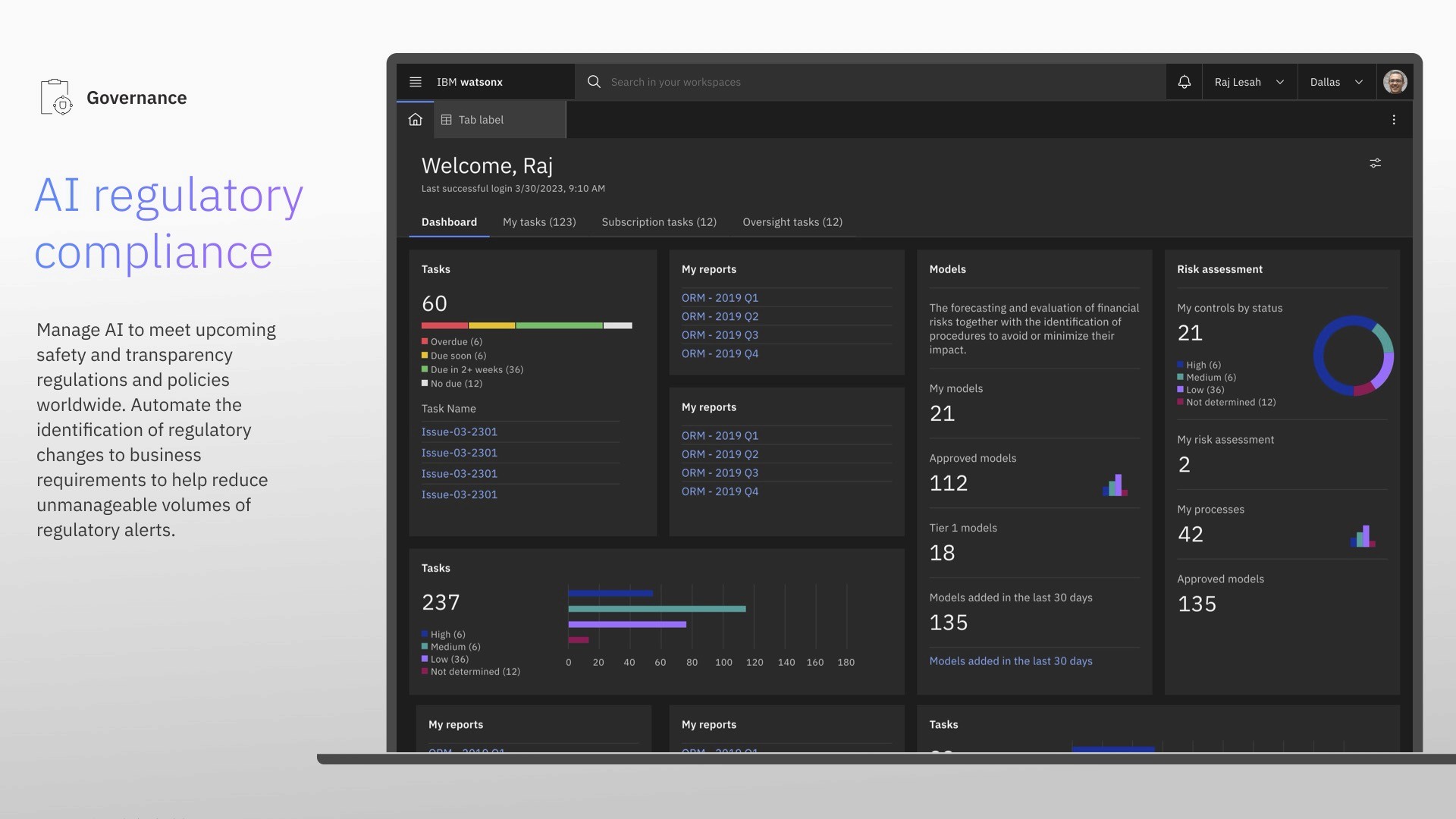
Compliance Management
Simplify compliance with an automated process of identifying regulatory requirements and translating them into enforceable policies.
End-To-End Experience
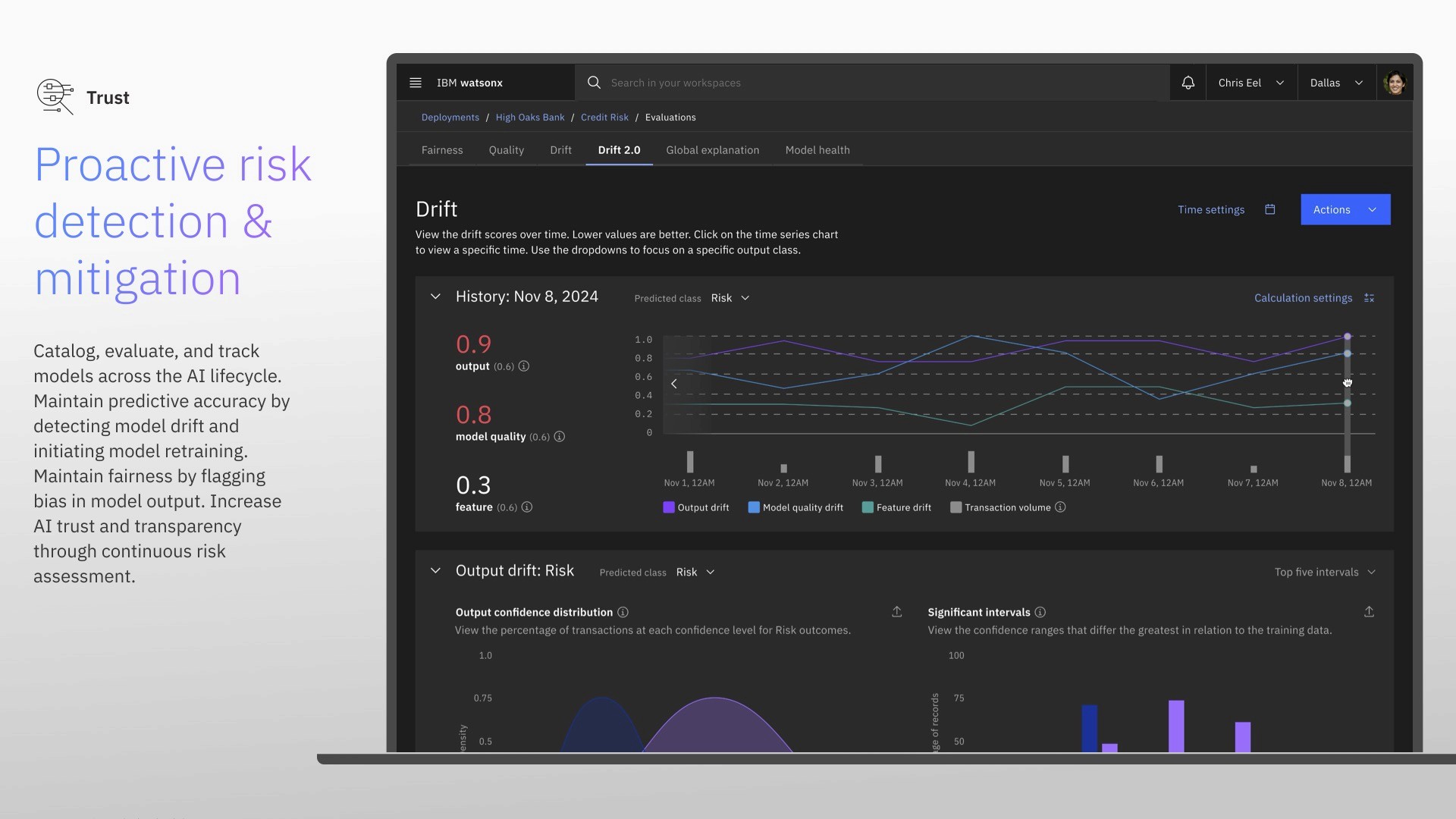
Proactively Detect and Mitigate Risks
Enabling users to identify potential risks and set safety guardrails for the development and deployment of AI models. Awareness of these guidelines and risk identification processes are vital to AI developers because they ensure that AI models are in alignment not only with political and social regulations, but also with organizational ethics and values.
Build & track AI lifecycle transparently
Applications and platforms that are not optimized for AI can lead to bias and security risks. watsonx.governance automatically captures critical information related to the lifecycle of an AI asset in easily digestible and sharable AI factsheets. These factsheets serve as a transparent overview of how an AI model was built, providing a clear path to understanding its underpinning components and mechanisms.
Compliance Management
Simplify compliance with an automated process of identifying regulatory requirements and translating them into enforceable policies.
End-To-End Experience
Impact
Impact
Industry Recognition
iF Gold Design Award 2024: Top 75 of 11,000 global entries.
IDC MarketScape Leader: First year in market.
Quantified Outcomes
25% faster compliance workflows.
10,000+ users across many large enterprises.
90% reduction in context-switching.
First unified platform in the market.
The Real Victory
AI developers now access business requirements, risk information, and compliance needs directly in their workflow. Risk & Compliance teams receive operational metrics automatically. The bridge between builders and protectors finally exists.
Industry Recognition
iF Gold Design Award 2024: Top 75 of 11,000 global entries.
IDC MarketScape Leader: First year in market.
Quantified Outcomes
25% faster compliance workflows.
10,000+ users across many large enterprises.
90% reduction in context-switching.
First unified platform in the market.
The Real Victory
AI developers now access business requirements, risk information, and compliance needs directly in their workflow. Risk & Compliance teams receive operational metrics automatically. The bridge between builders and protectors finally exists.
Reflection
Reflection
Lessons from Complexity
This project transformed my approach to enterprise UX. I learned that bringing disparate teams together requires more than good design—it requires becoming a translator, diplomat, and evangelist.
Leading the integration of OpenPages, OpenScale, and FactSheets taught me that the biggest design challenges aren't visual or interactive—they're organizational and cultural. The breakthrough came when I stopped trying to create one interface for everyone and started creating bridges between different worlds.
Key Learnings
Complexity requires structure, not simplification We didn't make governance simple—we made it navigable. Users can dive as deep as needed without getting lost.
Constraints drive innovation Seven months forced brutal prioritization. Every feature had to earn its place.
Governance enables speed When developers understand guardrails upfront, they build faster and with more confidence.
Lessons from Complexity
This project transformed my approach to enterprise UX. I learned that bringing disparate teams together requires more than good design—it requires becoming a translator, diplomat, and evangelist.
Leading the integration of OpenPages, OpenScale, and FactSheets taught me that the biggest design challenges aren't visual or interactive—they're organizational and cultural. The breakthrough came when I stopped trying to create one interface for everyone and started creating bridges between different worlds.
Key Learnings
Complexity requires structure, not simplification We didn't make governance simple—we made it navigable. Users can dive as deep as needed without getting lost.
Constraints drive innovation Seven months forced brutal prioritization. Every feature had to earn its place.
Governance enables speed When developers understand guardrails upfront, they build faster and with more confidence.
